Building infrastructure for how we will work tomorrow
The world is returning to the workplace but the office environment looks very different now. Many employees who were able to work efficiently at home during the pandemic are reluctant to go back to commuting to work five days a week. Companies have responded to this, in many cases by setting up a new way of working that lets employees work both from home and the office.
A Chartered Institute of Management (CMI) survey found that 84% of managers said their firms had adopted a hybrid working model, with employees working partly from home, and two-thirds said this had largely been prompted by the pandemic. In practice, the hybrid working model means that many of the working practices and processes as a result of the pandemic will continue. With some employees working from home or remotely, some perhaps hotdesking and others in the office permanently, collaboration technologies that came to the forefront during the pandemic are still central to the daily workflow. Despite many employees being together in the office, colleagues continue to use platforms such as Zoom, Teams and other cloud-based productivity software. At the beginning of the pandemic, when many employees were working from home, businesses were forced to rely on employees’ home internet-powered endpoints. Now with more workers in the office, the onus is on businesses to scale up to ensure that the network infrastructure can cope with everyone in the office making hundreds of concurrent VOIP calls. The task ahead is securely enabling home and remote working, while also ensuring that your office environment is fit for purpose. Enterprise IT leaders told us they face three key challenges in unlocking the future of work:
Challenge 1:
Enabling effective collaboration, ensuring it is consistent across regions and that all users have a good experience with the solution. Having the right systems in place to ensure productivity and efficiency needs to go hand in hand with developing an optimum user experience, both to retain existing staff and attract new employees during the current global recruitment crisis. Building and maintaining a robust network infrastructure is key to making all this work well. Joshua Bernstein, Director of Infrastructure Modernisation Solutions at Google, says: “Infrastructure has become a utility. It isn’t a nice to have, it’s a utility. And that level of robustness needs to evolve. Many companies are going to struggle with that. A lot is going to change, but I think it's going to focus on the strength of the network.”
Challenge 2:
Integrating collaboration platforms with customer-facing and back-office enterprise systems. This is not just to drive more efficient processes. For example, integrating your contact centre with a CRM system means you know who the customer is before they tell you – reducing agent time on the phone. Clever algorithms would also allow you to determine your customers’ problems before they even call. This way you can proactively solve problems and reduce calls into your contact centre. Integration with a collaboration system may allow the contact centre agent to get an answer to a question from a colleague while they are on the phone to the customer. This is a key focus for Hazem Elsayed, Director of IT - Lilly International Business Unit at Eli Lilly & Company. His focus is on giving end-customers a consistent experience when they contact any part of Eli Lilly. The goal is that each department should know everything about the customer and have access to all the customer’s previous interactions with Lilly, whether that is from an email, WhatsApp, webchat or voice call:
"
We are looking at how the company would interact with a unified approach and unified way of communication with one customer or set of customers while closing the loop between all the different functions inside the company."
Hazem Elsayed
Director of IT - Lilly International Business Unit,
Eli Lilly & Company

Challenge 3:
Secure transition to the cloud. The pandemic accelerated the journey to the cloud for many businesses. With many more employees working from home, the corporate network looked very different. Securing remote devices remains a huge challenge for many businesses. Understandably, everyone's worried about security, when there are multiple cloud-based communication tools linked to the corporate network but located remotely, all offering a potential route for criminals to get into your organisation.

"
The question became, how do I manage endpoint devices, laptops, at scale from a remote location? And how do I ensure data integrity and data security as employees are working more and more remotely?"
Joshua Bernstein
Director of Infrastructure Modernisation Solutions,
Future-proofing cloud collaboration with the security and features the business needs is taking place alongside unparalleled organisational change. Carlos Tse, IT Audit Manager at Aegon, says: “It’s very common in the insurance sector that employees work on documents collaboratively all the time. It’s quite hard to do that day in day out via Teams and has taken some getting used to. There are roles for ancillary tools around the core collaboration suite.” Many IT leaders told us that the human element of transforming collaboration was as important as technology considerations. Ivan Provaznik, Head of Infrastructure Department at Commerzbank, says: “Transition to effective collaboration is mostly about changing human behaviours. The challenge is to move employees from their traditional office management tools to the new platforms.”
Implementing Teams as a collaboration platform ranks highly with 79%
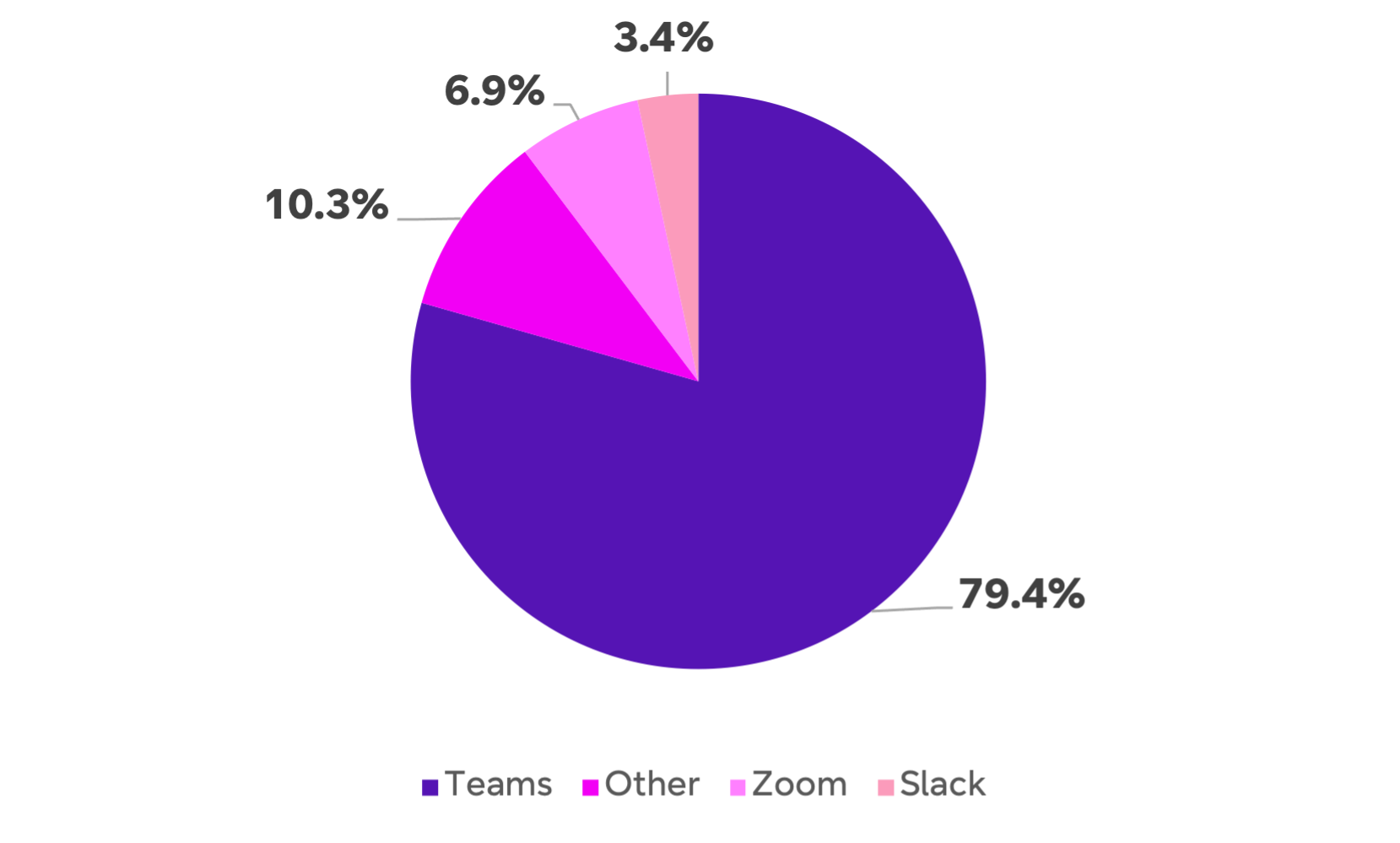
Source: BT/TechPros survey
Share this page