Optimising infrastructure – the calm after the storm
Now that businesses have begun to grow accustomed to the COVID induced working model, it's time to build on this in the more welcoming market conditions we hope to see later in 2021.
In a survey, we commissioned with CCS Insight, published September 2020, 62% of organisations said that there would be an increase in budget spend on internet connectivity over the next 12 months. And with this comes the need to review your security posture.
Most global businesses are some way on their journey through infrastructure transformation, making networks more resilient and secure and strengthening digital collaboration. However, infrastructure transformation is not a linear journey from A to B. It’s definitely not a one-way trip to the cloud. It involves creating a menu of options including cloud, on-premise and hybrid solutions. As traditional network perimeters blur, security threats change too.
Setting a strategy, with some wiggle room, is vital. “A cloud strategy is critical for every organisation and should be a concise point of view on cloud and its role in the organisation,” said an anonymous contributor. “Moving to cloud without a cloud strategy results in ad hoc adoption patterns, resulting in higher costs, disjointed management, security vulnerabilities and overall dissatisfaction with cloud outcomes.”2
When the pandemic hit, businesses were forced to act quickly, strategy or no strategy. Rick Casarez, Technical Director - Network Software Engineering and Operations at eBay, says, “For companies that weren't 100% remote from the beginning, what coronavirus has forced them to do was something of an afterthought. This includes security, as people are not going to be accessing sensitive data from a company-controlled site.
“Everyone's scattered. So now the question is, if we allow a VPN, how do we monitor that to make sure nothing bad is happening? I imagine there were a lot of companies scrambling to scale up their VPN technology or scale of their collaboration technology in order to continue to move forward.”

Christian Merkel,
Director IT UC | LogMeIn

Our default DNA was set to be able to work from anywhere at any time. We were fully digitalised. The unprecedented situation of coronavirus accelerated a natural progression, which had already happened for the business. We were almost bleeding edge. And it paid off big time, because we could focus not on the network but on all the customers and that’s what really helped us to propel forward.
As businesses look to balance the risks and rewards of digital transformation, they face a number of challenges on the way:
Challenge 1: Balancing business agility with operational certainty
The challenge of making the right choices faced with an increased rate of technological change makes for sleepless nights. The need to build resilience without suppressing innovation sees digital leaders walking a fine line between success and failure.
Network infrastructure has become business critical, the backbone for digital working and customer service. Customer experience is king and digital transformation must focus on enhancing user and customer experience, all without compromising security.
But companies can only focus on customer experience if the numbers stack up. Differentiation from competitors has to translate to the bottom line. Fergal Power, Vice-President-Indirect Sourcing & Global Real Estate at Aptiv says: “While most companies rightly place customer experience at the core of their decision-making, they are also heavily influenced by their operating margins. In any publicly floated company, your quarterly profit return is under scrutiny all the times so purely from an operating cost perspective, you need to know what a network transformation is going to deliver for you and how it will influence the competitive advantages you are trying to create.”
He adds, “It’s not just how well you are doing, it's how well you are doing compared to your competitors. In my business, I need to know I'm getting a better return than the other guy, not just a good return.”
A flexible network, where capacity may be dialled up and down as needed, can support evolving ambitions. The stress put on digital infrastructures during 2020 has, in many cases, put technology on the radar of business leaders beyond IT. Christian Merkel, Director IT UC at LogMeIn, says: “People started to understand, hey, that whole network thing, it's like the road I’m driving my BMW or Porsche on. If I’m driving on a rural road, which has holes and bumps, I can’t get up the speed I would going through the Nürburgring. Having a good network connection is just the thing. But we don’t always want to pay for the Nürburgring. And this is where the flexible, scalable network comes in where we pay for what we need.”
Challenge 2: Securing dispersed networks
Remote and mobile working and increased cloud service consumption are driving the demand to access business assets from anywhere, anytime on any device. The edges of networks are blurring. As the walls around company networks break down, it’s getting harder to lock the doors.
Johnny Krogsboll, Nordic Technical Director of security provider Trend Micro, says: “The amount of surfaces where you can make an entry into an organisation is increasing. You need to be able to protect much more than you would have had to two years back. We are moving from on-prem solutions and moving into the cloud. That’s a new surface for attack.”
According to McKinsey research, which covers more than 250 global CISOs and security professionals, coronavirus -inspired security measures were top budget priorities late into 2020. 70% of CISOs and security buyers believed budgets would shrink by the end of 2020 – but plan to ask for significant increases in 2021.3
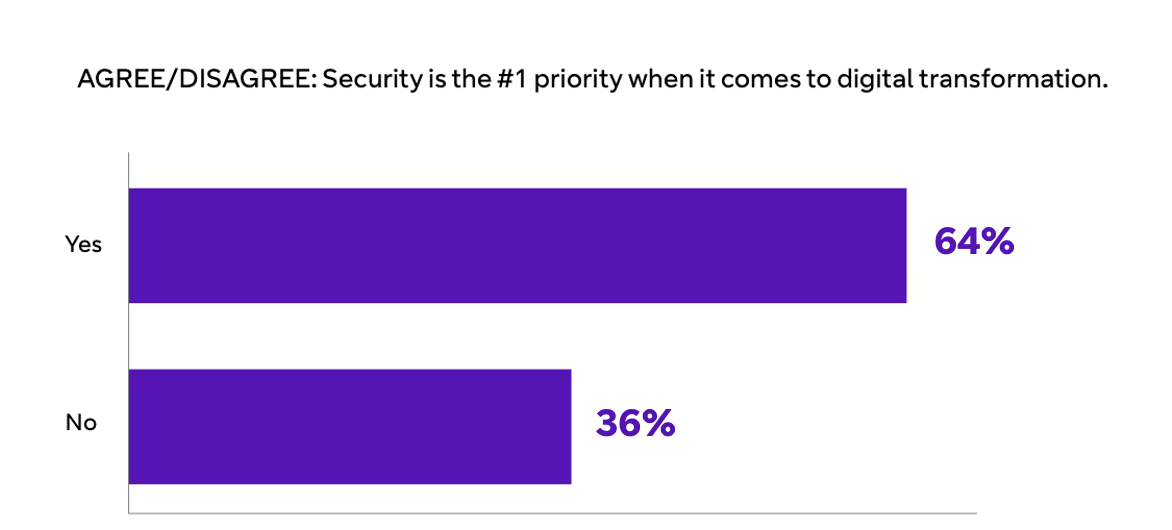
Prioritising security will continue to be crucial. Infrastructure optimisation should deliver cost efficiency. But that will only happen if security issues do not cloud the efficiency and customer experience gains.
Source: BT/Techpros survey

Johnny Krogsboll,
Nordic Technical Director | Trend Micro
We are bringing the production systems, the warehouses and manufacturing production closer to the corporate network. Those systems have typically not been designed to be protected from the outside world. There are more doors for the criminals to get in.
Challenge 3: Maintaining a common purpose for a diverse, dispersed organisation
Infrastructure optimisation sounds technical. But it’s about making things better for people. Allowing people to collaborate with colleagues and customers wherever they are. Balancing well-being and productivity is an ongoing challenge for most global businesses. Getting this right has a knock-on effect on attracting and keeping the right people. Digital collaboration platforms that allow people to work with each other effectively and productively wherever they are based have a major contribution to workplace wellbeing.
Customers and employees are increasingly interested in how companies operate beyond their core business. They want to see ethical behaviour and environmental responsibility. Infrastructure optimisation must be sustainable. Digitising operations ticks lots of boxes, reducing travel footprint and the need to maintain physical premises. But the supply chain and operations relating to the new infrastructure must be ethically sourced.
Your business outcomes are the sum of its people’s skills and the technology and ethical choices you make. Outsourcing to the cloud is not about outsourcing responsibility and ownership. Skilling up for digital transformation is still important – it’s not as simple as just outsourcing the issue. Bringing your people with you on the journey to digital collaboration is better for driving technology adoption in a diverse, dispersed workforce and fosters a sense of shared purpose.
Share this page