The age of the digital workplace
Remote working is here to stay. This is the dawning of the age of the digital workplace. Almost half of respondents to the CCS Insight Senior Leadership IT Investment Survey, August 20202, said that fewer than 10% of employees worked predominantly from home before the pandemic. But 61% of companies now expect more than a quarter of their employees will work mainly from home in the future.
Cloud and software-defined networking are key to the global workplace. According to CCS, cloud computing and remote collaboration were the main technology beneficiaries at the beginning of the health crisis. They also remain among the top priority investment areas this year.
Cloud and digital collaboration technologies are not the only ones seeing growth. Infrastructure as a service (IaaS) is expected to maintain healthy annual growth, due to the surge in cloud usage during the pandemic. Lockdowns also accelerated the transition to mobile devices and this is expected to continue3.
The challenges of accelerated technology transformation
Although many organisations were already set up to enable employees to work from home, most weren’t prepared to do so on such a large scale and so quickly. This accelerated technology transformation has brought with it a number of challenges, including providing standardised collaboration and meeting tools to support remote work, provisioning of IT hardware and devices, and scaling the infrastructure as well as information security challenges. Many organisations did not have standardised collaboration applications for remote working and as a result multiple platforms were deployed by different departments to fulfil their needs.
Business leaders need to make sure employees can access corporate applications or tools from home to the same standard as in the office, while meeting all the necessary privacy and compliance requirements. The key to success lies in the effective implementation of a digital workplace strategy capable of driving true cultural change.
Natasha Davydova, VP, CTO at Salesforce, says: “If your underlying technology doesn’t work, whether it’s bandwidth or connectivity or compatibility, then it won’t provide a super experience. It becomes very frustrating and people become disengaged. In many financial services companies, there are a lot of applications in data centres or in the cloud. But, when you connect to those applications from home, some companies are experiencing issues with latency.”
Security – no more sleepless nights transformation
The pandemic massively accelerated companies’ need for digital workplaces and unified communications. Yet there’s a real risk that companies are rushing through digital collaboration solutions without fully understanding what people need, both for effective working and for their well-being and to keep them engaged. At the same time, business leaders fear loss of control of workforce productivity and introducing security vulnerabilities.
Ananthakrishnan Jayaraman, Senior Director, IT Applications at Informatica, says: “Security - that’s the one that keeps me up. Making sure all of our artefacts and data are safe and that people use only the appropriate devices to access Informatica artefacts. That’s driving a lot of our tooling and application decisions.”
He adds, “Outside that, it’s more often a cultural issue, where it’s going to lead to lack of cohesion in the team, given the influx of new people coming in. So we’ll have to figure out new ways to get to know new people who will be working remotely. We’ll have to look at a new technical solution for this. This is critical for us - for a high performing team to continue to function effectively.”
There are many business and operational goals that could benefit from digital and remote working beyond responding to the current crisis - reducing office costs, providing better customer experience or introducing more flexible working, for example. Business leaders are under pressure to implement innovative and future-proof collaboration tools to get these benefits, without any disruption or risk. But it’s difficult to migrate to the cloud without some disruption and risk, ranging from customer dissatisfaction to loss of business.
A pivotal opportunity for transformation
Despite the challenges, business leaders are seizing a once in a generation opportunity to support more flexible and human ways of working that benefit both people and organisations. Natasha Davydova says: “This is a pivotal opportunity to transform the way that we work. The digital experience, both in the consumer space and in the employee space, is no longer a nice to have, it’s an imperative. I wouldn’t say everyone has gone digital overnight, it still is taking an effort. But I think everyone has, at least, culturally embraced it. And a lot of companies realise that if you don’t have a digital business, you might not have a business.”
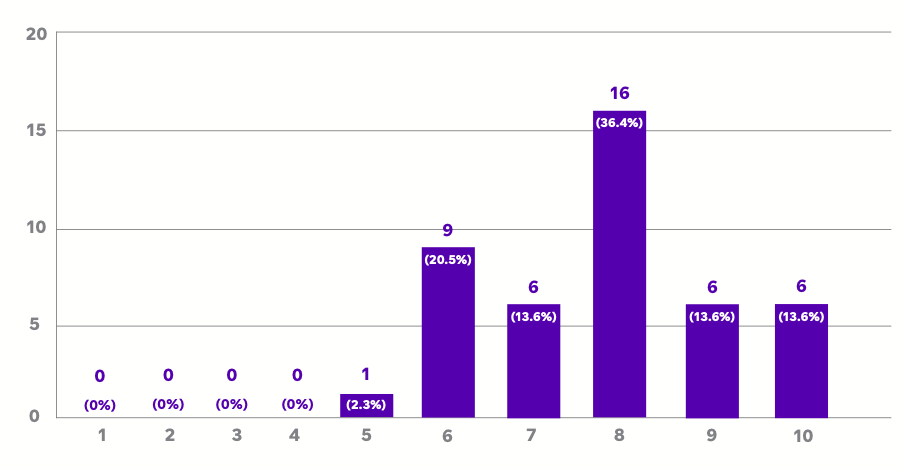
We asked business leaders, on a scale of 1-10, to what extent do you agree that remote working has increased productivity?
44 responses
Source: BT/Techpros survey

Natasha Davydova,
VP, CTO | Salesforce
Our workplace will evolve as a result of the pandemic and we will bring more empathy to our everyday connections. I think that empathy and how companies adjust to give people flexibility is very, very important.
Share this page